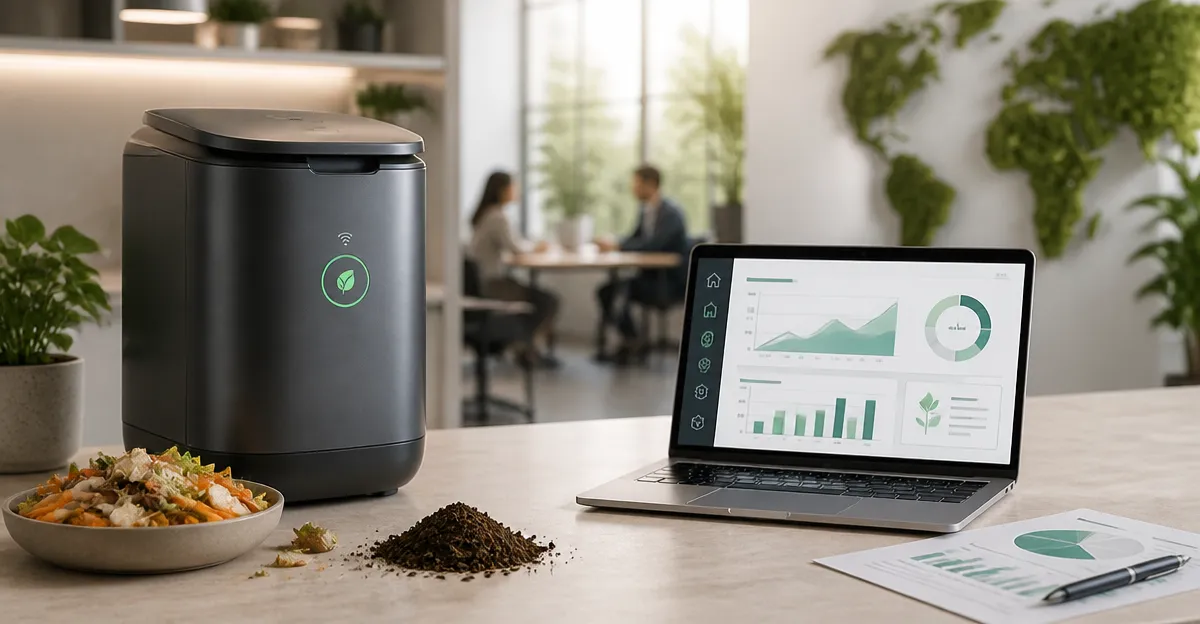
Ultimate Guide to Countertop Composter Telemetry
Introduction
Enterprises are increasingly seeking measurable ways to reduce their carbon footprint, and food‑waste management offers a tangible opportunity. This guide explains how telemetry from countertop composters can provide accurate data for corporate carbon accounting. Readers will learn the fundamentals of composting telemetry, how to integrate data into sustainability reporting, and which products deliver reliable performance. The guide also presents a comparison framework, best‑practice recommendations, and answers to common questions.
Background and Context
Food waste accounts for roughly 8 % of global greenhouse‑gas emissions, primarily through methane released from landfills. By converting organic waste into stable compost on site, organizations can avoid landfill emissions and generate a reusable soil amendment. Modern electric composters embed sensors that monitor temperature, humidity, and decomposition rate, transmitting data in real time. This telemetry enables precise calculation of avoided emissions, which can be reported in corporate sustainability dashboards.
Telemetry data typically includes:
- Capacity utilization (liters and percentage)
- Decomposition time per batch (hours)
- Odor and noise levels (decibels)
- Energy consumption (watts)
When combined with emission factors from recognized standards such as the GHG Protocol, the data can be transformed into carbon‑offset values. Accurate accounting requires consistent data capture, validation, and integration with existing carbon‑management software.
Understanding Telemetry in Countertop Composters
Telemetry is the process of automatically collecting and transmitting operational data from a device to a central system. In countertop composters, sensors track the biological environment inside the chamber and relay information via Wi‑Fi or Bluetooth. This data stream allows facilities managers to monitor performance, schedule maintenance, and verify that the composting process remains within optimal parameters.
Key telemetry features include:
- Real‑time temperature monitoring – ensures thermophilic conditions that destroy pathogens.
- Humidity sensors – maintain moisture levels that accelerate decomposition.
- Energy usage reporting – supports life‑cycle assessments of the device.
- Batch‑level waste input logging – provides the raw data needed for carbon‑offset calculations.
By exporting this information to a corporate sustainability platform, analysts can quantify the reduction in methane emissions compared with traditional landfill disposal.
Integrating Compost Data into Corporate Carbon Accounting
To translate telemetry into carbon‑accounting metrics, organizations should follow a structured workflow:
- Data ingestion: Connect the composter’s API to the enterprise data lake or carbon‑management software.
- Normalization: Convert raw sensor readings into standardized units (e.g., kilograms of waste processed per day).
- Emission factor application: Apply the appropriate factor, such as 1.0 kg CO₂e avoided per kilogram of food waste diverted from landfill.
- Reporting: Generate dashboards that display avoided emissions, waste reduction percentages, and device efficiency.
Many sustainability platforms already support custom data connectors; however, organizations may need to develop lightweight middleware to parse JSON payloads from the composter’s cloud service.
Choosing the Right Composter for Telemetry
Not all countertop composters provide the same level of telemetry granularity. The following products have been evaluated based on capacity, sensor suite, noise level, and integration capabilities.
1. Ouaken 4L Electric Composter
This model offers a 4‑liter chamber, odorless operation, and low‑noise motor. It includes an automatic cleaning cycle and a built‑in temperature sensor that reports data to a mobile app. The app provides daily summaries that can be exported as CSV for further analysis. Ideal for small offices seeking a compact device with basic telemetry.
2. Ouaken OK-255 5.5L Composter
The OK‑255 expands capacity to 5.5 liters and introduces five operational modes, including a rapid‑decomposition setting. It features a quiet motor, odor‑free technology, and an auto‑clean function. Telemetry is delivered via Wi‑Fi, enabling real‑time dashboards that display batch progress, energy use, and waste‑reduction metrics. This model suits medium‑size workspaces that require detailed reporting.
3. Reencle Prime 14L Electric Composter
With a 14‑liter capacity, the Reencle Prime is designed for high‑throughput environments such as corporate cafeterias. It decomposes up to 2.2 lb of waste daily, operates with whisper‑quiet technology, and provides a comprehensive telemetry suite that includes temperature, humidity, and power consumption. The device syncs with a cloud portal where data can be visualized and exported directly to carbon‑accounting tools.
4. 5L Electric Kitchen Composter
This unit offers a visible window, intelligent humidity sensor, and LED display. It is odorless and auto‑cleaning, and it provides Bluetooth telemetry that can be paired with a smartphone app. The app generates weekly reports on waste diverted and energy usage, making it suitable for teams that prefer mobile‑first data access.
Comparison and Selection Guide
The table below summarizes the key specifications and telemetry capabilities of each product, assisting decision‑makers in aligning device features with corporate sustainability goals.
| Product | Capacity | Telemetry Type | Noise Level | Auto‑Clean | Best Use Case |
|---|---|---|---|---|---|
| Ouaken 4L Electric Composter | 4 L | App‑based CSV export (Wi‑Fi) | Low | Yes | Small office or individual desk |
| Ouaken OK-255 5.5L Composter | 5.5 L | Real‑time dashboard (Wi‑Fi) | Quiet | Yes | Medium‑size workspace with reporting needs |
| Reencle Prime 14L Electric Composter | 14 L | Full cloud telemetry (Wi‑Fi) | Whisper‑quiet | Yes | Cafeteria or high‑volume kitchen |
| 5L Electric Kitchen Composter | 5 L | Bluetooth to mobile app | Low | Yes | Teams preferring mobile data capture |
Best Practices & Tips for Effective Implementation
To maximize the carbon‑accounting value of telemetry‑enabled composters, organizations should adopt the following practices:
- Standardize waste input logging: Train staff to record the type and weight of waste before loading the composter, ensuring that telemetry reflects actual material processed.
- Calibrate sensors annually: Verify temperature and humidity sensor accuracy against reference instruments to maintain data integrity.
- Integrate with existing sustainability software: Use APIs or middleware to feed telemetry directly into carbon‑management platforms, reducing manual data entry.
- Monitor energy consumption: Compare the device’s electricity use with the emissions avoided to confirm net positive impact.
- Report regularly: Publish quarterly dashboards that highlight waste diverted, emissions avoided, and cost savings, reinforcing stakeholder engagement.
Additionally, organizations can set thresholds for alerts—such as temperature deviations—that trigger maintenance, thereby preserving optimal decomposition rates and data quality.
Frequently Asked Questions
- How accurate is telemetry data for carbon accounting? When sensors are calibrated and waste inputs are logged consistently, telemetry can achieve accuracy within ±5 % for emissions avoided calculations.
- Do these composters require external power? All four devices operate on standard AC power; energy consumption ranges from 30 W to 60 W per hour of active composting.
- Can the data be exported to third‑party platforms? Yes, each product provides either CSV export, Bluetooth syncing, or cloud API access that can be integrated with most sustainability software.
- What is the expected lifespan of a countertop composter? With regular maintenance and auto‑clean cycles, manufacturers typically guarantee up to five years of operation.
- Is odor truly eliminated? Odor‑free technology relies on sealed chambers and active carbon filters; user reports indicate negligible smell when the unit operates within design parameters.
- How much waste can be processed daily? Capacities vary: the 4 L model handles approximately 0.5 kg per day, the 5.5 L model up to 0.8 kg, the 14 L model up to 1 kg, and the 5 L model around 0.6 kg.
- Are these units safe for office environments? All models meet safety certifications for indoor use, featuring low‑noise motors and automatic shut‑off mechanisms.
Conclusion
Telemetry‑enabled countertop composters provide a data‑driven pathway for organizations to quantify and report food‑waste reductions, thereby enhancing corporate carbon accounting. By selecting a device that aligns with capacity needs, sensor fidelity, and integration capabilities, enterprises can turn kitchen scraps into measurable sustainability assets. Implementing the best‑practice framework outlined in this guide ensures data accuracy, operational efficiency, and transparent reporting for stakeholders.
Products Featured in This Guide
Ouaken 4L Electric Composter
Price: N/A
Rating: N/A
Why featured: Compact size, odorless operation, low noise, and basic telemetry suitable for small offices.
Ouaken OK-255 5.5L Composter
Price: N/A
Rating: N/A
Why featured: Larger capacity, multiple modes, quiet operation, and robust Wi‑Fi telemetry for medium‑scale reporting.
Reencle Prime 14L Electric Composter
Price: N/A
Rating: N/A
Why featured: High capacity, rapid decomposition, whisper‑quiet technology, and comprehensive cloud telemetry for high‑volume environments.
5L Electric Kitchen Composter
Price: N/A
Rating: N/A
Why featured: Visible window, intelligent humidity sensor, Bluetooth telemetry, and mobile‑first reporting for flexible deployments.