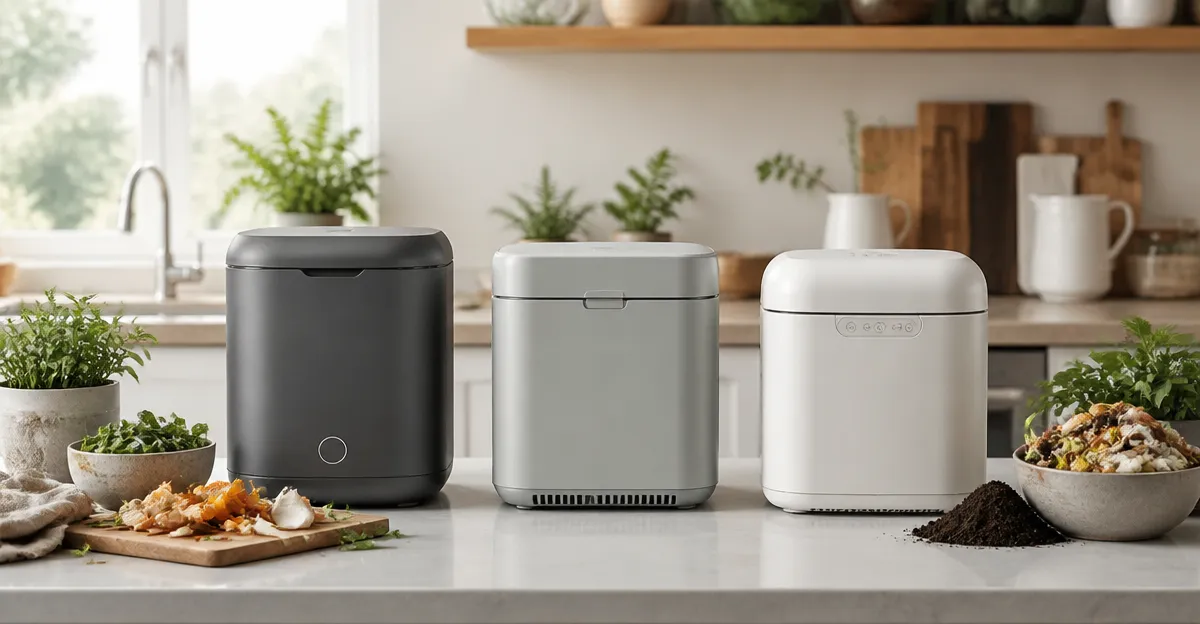
Best Mid‑Range Countertop Composters Under $400: Buying Guide & Comparison
Introduction
The modern kitchen increasingly demands appliances that are both space‑efficient and environmentally responsible. Countertop composters fulfill that demand by turning everyday food scraps into usable fertilizer while occupying only a fraction of a traditional outdoor bin. This guide explains how countertop composters work, outlines the most important buying criteria, and compares four mid‑range models that are all priced below $400. Readers will finish with a clear understanding of which unit best matches their household size, waste‑type preferences, and budget.
Background and Context
Composting on the countertop relies on three core processes: high‑temperature drying, mechanical grinding, and odor‑control filtration. Drying removes moisture, grinding reduces particle size, and activated‑carbon filters capture volatile compounds that cause odor. The result is a dry, powder‑like material that can be mixed into garden soil or stored for later use. Unlike outdoor compost piles, which may take months to mature, countertop units produce a usable product in 2–5 hours, making them ideal for apartments, small homes, or anyone who wishes to avoid the mess and smell of traditional composting.
Key technical terms often appear in product literature. High‑torque blades refer to motor‑driven cutters that maintain cutting power even when the material becomes dense. Carbon filter lifespan indicates how many months of effective odor control can be expected before replacement is required. Understanding these terms helps buyers evaluate performance claims objectively.
Key Concepts and Product Categories
Countertop composters fall into two broad categories based on capacity: small (2‑3 L) units suitable for one‑to‑two‑person households, and larger (4‑5.5 L) units that accommodate families of four or more. Capacity influences cycle time, frequency of use, and the need for pre‑processing (e.g., chopping large vegetables). Another distinction is the presence of a transparent visual cover, which allows users to monitor the drying process in real time. Finally, warranty length and post‑sale support are critical for long‑term satisfaction.
The following products represent the most popular options in the sub‑$400 segment:
- Airthereal R500-V Electric Composter
- Ouaken 4L Electric Composter
- Ouaken 4L Electric Composter (alternate listing)
- Ouaken 5.5L Electric Composter
- Airthereal R500 Electric Composter
Product Comparisons
| Model | Capacity | Cycle Time | Noise Level | Filter Life | Price (USD) | Rating |
|---|---|---|---|---|---|---|
| Airthereal R500-V | 2.5 L | 2‑5 hrs (depends on load) | Quiet (under 40 dB) | Biodegradable carbon filter (up to 6 months) | 189.99 | 4.5/5 (217 reviews) |
| Ouaken 4L (B0F2697XCD) | 4 L | ≈3 hrs | Below 40 dB | Large‑capacity carbon filter (≈5 months) | 218.49 | 4.3/5 (600 reviews) |
| Ouaken 4L (B0DJVJRP13) | 4 L | ≈3 hrs | Below 40 dB | Large‑capacity carbon filter (≈5 months) | 219.99 | 4.3/5 (600 reviews) |
| Ouaken 5.5L | 5.5 L | 2‑4 hrs (quick mode) | Below 45 dB | Enhanced iodine‑value filter (≈5 months) | 279.99 | 4.4/5 (56 reviews) |
| Airthereal R500 | 2.5 L | ≈4 hrs | Quiet | Biodegradable carbon filter (≈6 months) | 159.99 | 4.2/5 (734 reviews) |
Why Capacity Matters
For a single individual or a couple, a 2.5 L unit such as the Airthereal R500 provides enough space to hold a day's worth of scraps. Larger families benefit from the 4 L or 5.5 L models, which reduce the number of daily cycles and therefore lower electricity consumption.
Blade Technology and Reliability
Both Airthereal and Ouaken employ high‑torque, serrated blades. Airthereal markets its “SHARKSDEN Tri‑Blade” that cuts from multiple angles, while Ouaken references a “low‑speed, high‑torque” design. User reviews consistently note that these blades handle soft vegetable matter well; however, occasional clumping can occur if excess moisture is present. The Ouaken 5.5L adds a reinforced 9H non‑stick coating that reduces residue buildup.
Odor Control
All models include an activated‑carbon filter. The Airthereal units use biodegradable filters, which appeal to environmentally conscious users. Ouaken’s larger filters last up to five months before replacement, a practical advantage for households that run the machine multiple times per day.
Selection Guide: Choosing the Right Countertop Composter
- Determine Household Size and Waste Volume. Estimate the daily amount of peels, cores, and coffee grounds. If the total exceeds one litre per day, a 4 L or larger model will prevent frequent reloads.
- Assess Kitchen Space. Measure countertop width and depth. The Airthereal R500‑V and R500 have a compact footprint, while the Ouaken 5.5L requires a slightly larger area due to its oval profile.
- Consider Noise Sensitivity. All models operate below 45 dB, but the Airthereal series is noted for being “very, very quiet,” making it suitable for open‑plan living spaces.
- Evaluate Filter Maintenance. If you prefer a biodegradable solution, choose Airthereal. If you want a longer‑lasting filter with fewer replacements, the Ouaken models are preferable.
- Budget Constraints. Prices range from $159.99 to $279.99. The Airthereal R500 provides the lowest entry point, while the Ouaken 5.5L offers the most capacity for a modest premium.
Best Practices & Tips for Optimal Composting
- Balance Greens and Browns. Aim for a ratio of roughly 1 part greens (vegetable scraps) to 2‑3 parts browns (dry leaves, paper, pine needles). This balance reduces moisture and prevents clumping.
- Pre‑Cut Large Items. Chop carrots, squash, or fruit skins into 1‑inch pieces before loading. Smaller pieces dry more evenly and reduce strain on the blades.
- Run Empty Cycles After Jams. If the machine stops mid‑cycle, run an empty cycle to clear residual heat and moisture before starting a new batch.
- Maintain the Carbon Filter. Replace the filter according to the manufacturer’s schedule (approximately every 5‑6 months) to sustain odor‑free operation.
- Use the Product’s Cleaning Mode. Both Ouaken models feature an auto‑clean function that flushes water through the system, simplifying maintenance.
- Store the Finished Product Properly. Transfer the dry powder to a sealed container or directly mix it into garden soil. If stored for longer than a month, keep it in a cool, dry place to avoid mold growth.
Frequently Asked Questions
- 1. Can I compost meat or dairy?
- Manufacturers allow small amounts of meat or cheese, but most users avoid them because they increase odor risk and can cause clumping. The safest approach is to limit animal protein to occasional, finely chopped pieces.
- 2. How much electricity does a countertop composter use?
- Typical units draw between 300‑500 W during a cycle. Running a 3‑hour cycle therefore consumes roughly 1‑1.5 kWh, comparable to a short dishwasher run.
- 3. Is the output ready to use as garden fertilizer?
- The product is a dry, partially decomposed powder. It enriches soil quickly but benefits from a brief outdoor curing period to complete the composting process.
- 4. What happens if the filter becomes saturated?
- Odor may become noticeable, and the machine could overheat. Replace the filter according to the schedule (5‑6 months) to maintain performance.
- 5. Can I place the unit under a cabinet?
- Yes, provided there is clearance for ventilation. Users of the Airthereal R500‑V report that steam exits the vent, so ensure the vent does not face a wall that could be damaged.
- 6. How often should I empty the bucket?
- Empty after each cycle to avoid moisture buildup. The Ouaken 5.5L explicitly advises clearing the bucket before starting a new run to prevent clumping.
Conclusion
Countertop composters deliver a convenient path to reducing household waste while producing valuable organic matter for gardens. By evaluating capacity, blade reliability, filter type, noise level, and price, consumers can select a model that aligns with their lifestyle. The Airthereal R500‑V and R500 provide compact, quiet solutions for small households, whereas the Ouaken 4 L and 5.5 L models excel for families that generate larger volumes of scraps. Following the best‑practice tips ensures consistent performance and a pleasant, odor‑free kitchen environment.
Products Featured in This Guide
Airthereal R500-V Electric Composter
Price: $189.99 | Rating: 4.5/5 (217 reviews)
Featured for its transparent visual cover, upgraded tri‑blade system, and 3‑year warranty that adds extra protection for Amazon customers.
Ouaken 4L Electric Composter
Price: $218.49 | Rating: 4.3/5 (600 reviews)
Featured for its 4 L capacity, quiet operation, and versatile mode selection (Crush, Ferment, Clean) that suits varied composting goals.
Ouaken 4L Electric Composter (alternate listing)
Price: $219.99 | Rating: 4.3/5 (600 reviews)
Featured for identical performance to the primary 4 L model but listed under a separate ASIN, offering consumers additional purchasing options.
Ouaken 5.5L Electric Composter
Price: $279.99 | Rating: 4.4/5 (56 reviews)
Featured for its larger 5.5 L capacity, five operating modes, and upgraded odor‑control system that includes an iodine‑enhanced carbon filter.
Airthereal R500 Electric Composter
Price: $159.99 | Rating: 4.2/5 (734 reviews)
Featured for its affordability, reliable SHARKSDEN Trinity Blade, and biodegradable carbon filter that aligns with eco‑conscious households.