Accessible Countertop Composters for Limited Mobility Users: The Ultimate Guide to Easy, Hands-Free & Ergonomic Options
Introduction
This guide explains how countertop composters can be integrated into a kitchen environment when the user has limited mobility. Readers will learn essential ergonomic considerations, discover hands‑free features, and receive product recommendations that combine safety with convenience. The article also provides a comparison framework, best‑practice tips, and answers to frequently asked questions. By the end of the guide, one will be able to select a composter that reduces physical strain while maintaining effective waste reduction.
Background and Context
Composting transforms organic kitchen waste into valuable fertilizer, yet traditional methods often require repetitive bending, heavy lifting, and manual turning of material. For individuals with reduced strength, arthritis, or limited reach, these tasks can become barriers to sustainable living. Modern electric countertop composters address these challenges by automating grinding, drying, and odor control within a compact footprint. Understanding the technology behind high‑temperature drying, micro‑be microbial action, and carbon‑filter odor mitigation is essential for making an informed purchase.
Key technical terms include:
- High‑temperature drying: Heat applied to reduce moisture, accelerating decomposition and minimizing odor.
- Micro‑be technology: Engineered microorganisms that break down organic matter quickly without producing unpleasant smells.
- Carbon filter: Activated charcoal that adsorbs volatile compounds, keeping the kitchen environment fresh.
When these mechanisms are combined with intuitive controls, the user can operate the device with a single button press, thereby reducing the need for repetitive hand motions.
Ergonomic Features to Prioritize
For limited mobility users, the following features should be evaluated carefully:
- One‑Touch Operation: A single button that starts the composting cycle eliminates the need for complex menu navigation.
- Quiet Motor Design: Noise levels below 40 dB allow operation at any time of day without disturbing the user or household.
- Transparent Lid or LED Display: Visual feedback on cycle progress reduces the need to open the unit repeatedly.
- Detachable, Dishwasher‑Safe Components: Easy removal of the bucket or blade simplifies cleaning without excessive manual effort.
- Compact Footprint: A width of less than 12 inches fits comfortably on most countertops, leaving space for other utensils.
When these criteria are met, the composter becomes a truly hands‑free solution that supports independence.
Product Recommendations
The following products exemplify the ergonomic principles outlined above. Each product is introduced with its friendly name linked to the Amazon listing; subsequent mentions are plain text.
1. Ouaken 4L Electric Composter
This countertop unit offers a 4‑liter capacity, making it suitable for a family’s daily waste. The device uses high‑temperature drying, grinding, and cooling to reduce waste volume by up to 90 percent within hours. Noise remains below 40 dBA, allowing night‑time operation without disturbance. A large carbon filter provides up to five months of odor control, and the easy‑touch interface presents three modes: Crush, Ferment, and Clean. The detachable bucket is dishwasher safe, which aligns with the need for low‑effort maintenance.
Key specifications:
- Capacity: 4 L
- Price: $219.99
- Rating: 4.2/5 from 928 reviews
- Noise: <40 dBA
- Carbon filter lifespan: up to 5 months
2. Saluna 4L Electric Composter
Saluna’s model emphasizes visual monitoring with a clear lid and a smart LED display. The unit provides three composting modes and an auto‑clean function that activates with a single press. Dual activated carbon filters enhance odor control, and the removable dishwasher‑safe bucket simplifies cleaning. Its sleek design fits modern kitchens while delivering a quiet operation comparable to the Ouaken model.
Key specifications:
- Capacity: 4 L
- Price: $249.99
- Rating: 5/5 from 46 reviews
- LED display for cycle time
- Dual carbon filters for odor reduction
3. Reencle Prime 14L Electric Composter
The Reencle Prime offers a larger 14‑liter capacity, suitable for households that generate more waste. Patented micro‑be technology accelerates decomposition, converting up to 2.2 lb of food scraps into dry compost within 2‑24 hours. A three‑layer filter system maintains an odor‑free environment, and whisper‑quiet technology operates at as low as 28 dB. The package includes a carbon filter, starter pack, and shovel, ensuring a ready‑to‑use experience.
Key specifications:
- Capacity: 14 L
- Price: $499.00
- Rating: 4.4/5 from 372 reviews
- Noise: 28 dB
- Micro‑be decomposition
4. Epica Kitchen Compost Bin
Epica provides a non‑electric, passive composting solution that relies on a charcoal filter and airtight lid to control odor. The stainless‑steel construction resists rust and leaks, and the 1.3‑gallon capacity fits comfortably on most countertops. While it does not automate grinding, the simplicity of a manual bin can be advantageous for users who prefer minimal technology and low maintenance.
Key specifications:
- Capacity: 1.3 gal (≈4.9 L)
- Price: $29.98
- Rating: 4.6/5 from 20,864 reviews
- Charcoal filter lifespan: 3‑6 months
- Stainless‑steel, rust‑proof design
5. Natridy Electric Kitchen Composter
Natridy’s model introduces an industry‑first detachable blade, allowing the user to rinse the cutting component without tools. The unit operates at 40 dB, comparable to a quiet conversation, and includes a double‑layer carbon filter for superior odor control. The ceramic‑coated bucket and brushless motor are rated for 10,000 hours of use, ensuring durability for long‑term operation. Its Japanese‑inspired aesthetic blends seamlessly with contemporary kitchen décor.
Key specifications:
- Capacity: 100 oz (≈2.9 L)
- Price: $229.99
- Rating: 4.9/5 from 24 reviews
- Noise: 40 dB
- Detachable blade and auto‑flush cleaning
Comparison and Selection Guide
To assist limited mobility users in selecting the appropriate composter, the following matrix evaluates each model against core ergonomic criteria.
| Feature | Ouaken 4L | Saluna 4L | Reencle Prime 14L | Epica Bin | Natridy 2.9L |
|---|---|---|---|---|---|
| One‑Touch Operation | Yes | Yes | Yes | No (manual) | Yes |
| Noise Level | <40 dBA | Quiet (unspecified) | 28 dB | Silent (no motor) | 40 dB |
| Capacity | 4 L | 4 L | 14 L | 4.9 L | 2.9 L |
| Carbon Filter Longevity | 5 months | Dual, replaceable | 3‑layer, replaceable | 3‑6 months | Double, high capacity |
| Cleaning Ease | Dishwasher‑safe bucket | Auto‑clean + dishwasher bucket | Standard bucket | Hand‑wash | Detachable blade + auto‑flush |
| Price | $219.99 | $249.99 | $499.00 | $29.98 | $229.99 |
| Rating (out of 5) | 4.2 | 5.0 | 4.4 | 4.6 | 4.9 |
Users who prioritize a larger capacity and rapid microbial action may favor the Reencle Prime, despite its higher price point. Those who require the simplest maintenance and a modest footprint may find the Ouaken or Saluna models more suitable. The Epica Bin offers a low‑cost, electricity‑free alternative for users who can manage manual turning. The Natridy unit stands out for its detachable blade, which reduces cleaning effort for individuals with limited grip strength.
Best Practices & Tips for Hands‑Free Composting
- Pre‑Sort Waste: Separate large bones, shells, and fibrous materials before loading. This reduces processing time and prevents motor strain.
- Maintain Dry‑Wet Balance: Combine wet scraps with dry paper or sawdust to aid the drying cycle and minimize odor.
- Empty Regularly: For electric models, empty the bucket after each cycle to avoid clumping, which can increase motor load.
- Replace Carbon Filters Promptly: A saturated filter reduces odor control and may increase the perceived need to open the unit.
- Use One‑Touch Modes: Select the preset mode that matches the waste type; this eliminates the need for manual adjustments.
- Position Near Power Source: Place the composter within easy reach of an outlet to avoid pulling cords across the workspace.
- Leverage Accessibility Tools: A lightweight rolling cart can transport the unit for cleaning or repositioning without lifting.
Implementing these practices maximizes the ergonomic benefits of the chosen composter while preserving its efficiency.
Frequently Asked Questions
- Can countertop composters handle meat and dairy? Most electric models, such as the Reencle Prime and Natridy, are designed to process small amounts of meat and dairy when mixed with dry material. The Epica manual bin is not recommended for high‑protein waste because it can generate stronger odors.
- How often must the carbon filter be replaced? Replacement intervals vary by usage. The Ouaken filter lasts up to five months, while the Epica and Saluna filters typically require replacement every three to six months.
- Is the noise level safe for individuals with hearing sensitivities? Units operating below 40 dB, such as the Ouaken, Natridy, and Reencle Prime (28 dB), are comparable to a quiet conversation and are generally safe for sensitive users.
- Do these appliances require special installation? No special installation is required. Simply place the unit on a stable, heat‑resistant surface, plug it into a standard 110‑120 V outlet, and follow the manufacturer’s setup guide.
- What happens to the compost after a cycle? The output is a dry, crumbly material that can be mixed into garden soil, added to potting mixes, or used as a top‑dressing for indoor plants.
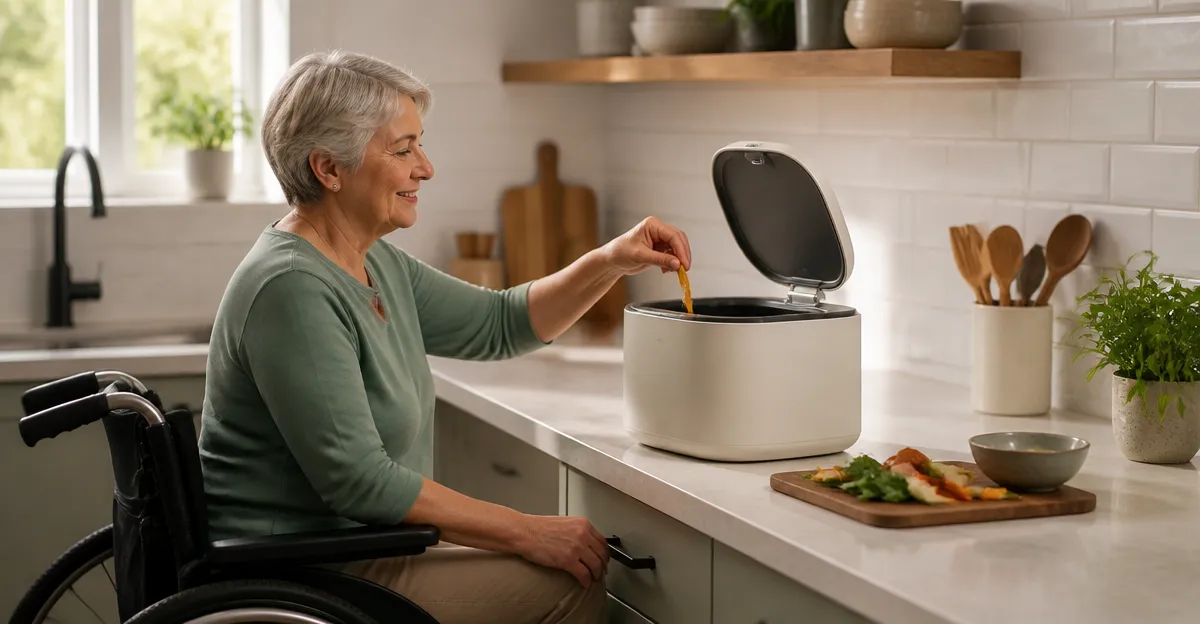
- Can the units be used by wheelchair users? Yes, provided the countertop height is within reach. Selecting a model with a low‑profile design and one‑touch operation minimizes the need for bending or reaching.
- Are there any safety certifications? Most units comply with UL or CE safety standards, indicating they have undergone electrical safety testing.
Conclusion
Accessible countertop composters empower individuals with limited mobility to participate in sustainable waste management without compromising comfort or safety. By focusing on one‑touch controls, low noise, easy cleaning, and reliable odor control, users can achieve hands‑free operation that aligns with daily routines. The products highlighted in this guide demonstrate a range of capacities, price points, and technological approaches, enabling a tailored selection based on personal needs. Implementing the best‑practice tips ensures long‑term satisfaction and maximizes the environmental benefits of indoor composting.
Products Featured in This Guide
Ouaken 4L Electric Composter
Price: $219.99 | Rating: 4.2/5 (928 reviews)
Featured for its compact 4 L capacity, quiet operation, and dishwasher‑safe bucket, making it ideal for users who need a low‑effort, hands‑free solution.
Saluna 4L Electric Composter
Price: $249.99 | Rating: 5/5 (46 reviews)
Featured for its clear viewing window, smart LED display, and dual carbon filters that provide visual feedback and superior odor control.
Reencle Prime 14L Electric Composter
Price: $499.00 | Rating: 4.4/5 (372 reviews)
Featured for its large 14 L capacity, micro‑be technology, and whisper‑quiet 28 dB operation, suitable for households with higher waste volumes.
Epica Kitchen Compost Bin
Price: $29.98 | Rating: 4.6/5 (20,864 reviews)
Featured as an affordable, passive composting option with a stainless‑steel body and charcoal filter, ideal for users who prefer a simple, electricity‑free solution.
Natridy Electric Kitchen Composter
Price: $229.99 | Rating: 4.9/5 (24 reviews)
Featured for its detachable blade, double carbon filter, and Japanese‑inspired design that simplifies cleaning and enhances ergonomic use.