Introduction
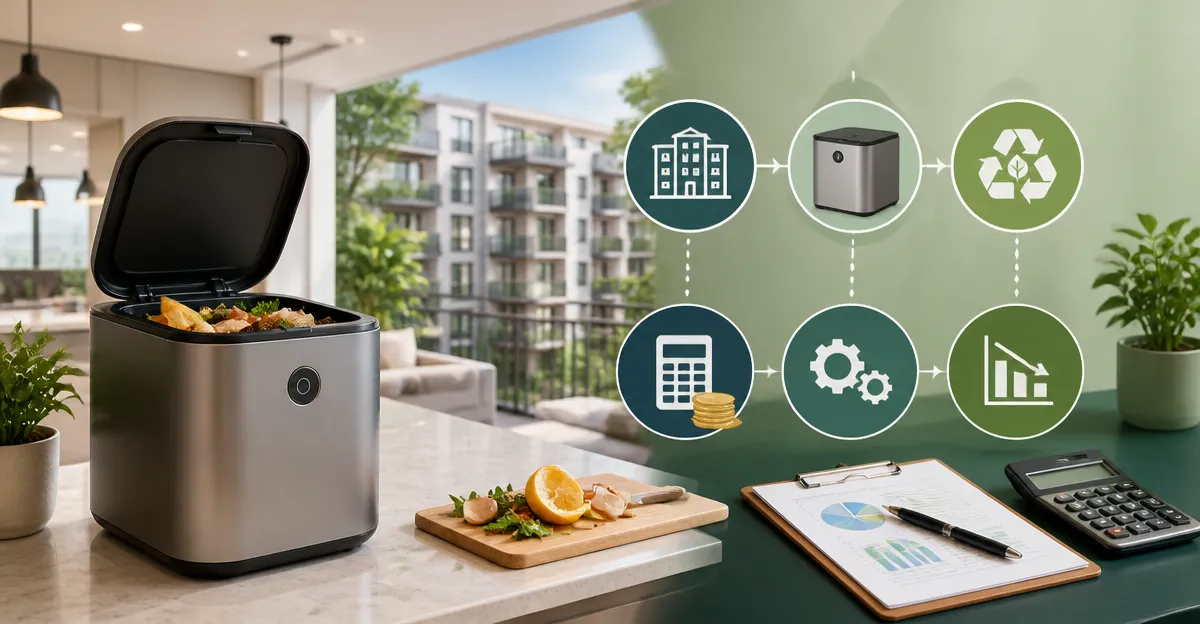
This guide examines the financial implications of installing countertop composters in multi‑family properties. Readers will understand the distinction between capital expenditures (CapEx) and operating expenditures (OpEx), learn how to calculate return on investment (ROI), and discover best practices for sustainable waste management. The discussion includes a detailed product recommendation that aligns with both cost categories. By the end of the article, property managers will be equipped to make informed decisions that balance environmental goals with budgetary constraints.
Background and Context
Multi‑family residential complexes generate significant organic waste, often exceeding the capacity of municipal collection services. Traditional waste streams rely on landfilling, which contributes to greenhouse‑gas emissions and incurs disposal fees. Countertop composters provide an on‑site solution that transforms food scraps into valuable fertilizer for landscaping or resident gardens. Understanding the financial structure of such installations requires familiarity with two core concepts: CapEx, which covers upfront purchase and installation costs, and OpEx, which encompasses ongoing energy, maintenance, and consumable expenses.
CapEx typically includes the purchase price of the composter, any required electrical work, and integration with building management systems. OpEx includes electricity consumption, filter replacements, carbon filter consumables, and routine servicing. A clear separation of these cost streams enables property owners to allocate budgets, secure financing, and evaluate long‑term sustainability.
Key Concepts for Financial Planning
Capital Expenditure (CapEx) represents the initial outlay required to acquire and install the equipment. For countertop composters, the primary CapEx item is the unit price. Additional costs may arise from structural modifications, such as reinforcing countertops or providing dedicated ventilation. These expenses are usually amortized over the useful life of the equipment, commonly five to seven years for residential appliances.
Operating Expenditure (OpEx) covers recurring costs that sustain the composting process. Energy consumption is a major component; many modern units operate at low wattage, reducing electricity bills. Consumables such as carbon filters and microbial starter packs also contribute to OpEx. Maintenance contracts or warranty extensions can be factored into the operating budget to ensure uninterrupted service.
Return on Investment (ROI) measures the financial benefit derived from reduced waste disposal fees and potential revenue from compost sales or landscaping cost savings. ROI calculations should incorporate both CapEx depreciation and OpEx over the analysis period. A positive ROI indicates that the composting system pays for itself within the projected timeframe.
Product Recommendation: Reencle Prime Electric Composter
The Reencle Prime Electric Composter is a 14‑liter countertop unit designed for indoor use. It processes up to 2.2 lbs of food waste daily, delivering odor‑free operation through a three‑layer filtration system. The device operates at a noise level as low as 28 dB, making it suitable for apartment environments where quiet is essential.
Key specifications include a sleek silver finish, whisper‑quiet technology, and an energy‑efficient motor that consumes minimal power. The package contains a carbon filter, compost starter pack, and a shovel, ensuring a complete setup out of the box. Customer reviews average 4.4 out of 5 stars based on 365 evaluations, highlighting reliability, low odor, and ease of use.
From a financial perspective, the unit’s price of $499.00 represents the primary CapEx component. The energy draw is modest, translating to an estimated annual electricity cost of less than $20 for typical usage. The carbon filter, designed for long‑term service, has not required replacement in the first six months of operation for many users, further reducing OpEx. These attributes make the Reencle Prime an attractive option for property managers seeking a balance between upfront cost and ongoing expenses.
Cost Breakdown and ROI Calculation
Below is a sample cost model for a 50‑unit multi‑family building installing one Reencle Prime per unit. All figures are illustrative and should be adjusted for local utility rates and waste‑disposal contracts.
| Cost Category | Amount per Unit | Total for 50 Units |
|---|---|---|
| CapEx – Unit Purchase | $499.00 | $24,950.00 |
| CapEx – Installation (electrical, mounting) | $50.00 | $2,500.00 |
| OpEx – Annual Electricity | $20.00 | $1,000.00 |
| OpEx – Filter Replacement (every 2 years) | $15.00 | $750.00 (annualized) |
| Total First‑Year Cost | $29,200.00 |
Assuming the building currently pays $30 per ton for organic waste collection, and each unit generates approximately 0.2 tons of food waste annually, the total waste avoided equals 10 tons per year. This avoidance yields a cost saving of $300 per year. Additionally, the compost produced can offset landscaping fertilizer expenses estimated at $150 per year.
Therefore, total annual financial benefit equals $450. Over a five‑year horizon, cumulative savings reach $2,250, while total costs (including depreciation of CapEx) approximate $14,600. The resulting ROI is roughly 15 %, indicating a modest but positive financial outcome. Property managers can improve ROI by negotiating bulk purchase discounts, seeking rebates for energy‑efficient appliances, or integrating compost use into community garden programs that generate ancillary revenue.
Comparison and Selection Guide
When evaluating countertop composters for multi‑family installations, consider the following criteria:
- Processing Capacity – Units should handle the average daily waste generated per resident. The Reencle Prime’s 2.2 lb capacity aligns well with typical apartment usage.
- Noise Level – Quiet operation (<30 dB) is essential for shared living spaces.
- Odor Control – Multi‑layer filtration reduces complaints and maintains indoor air quality.
- Energy Consumption – Lower wattage reduces OpEx and supports sustainability goals.
- Maintenance Requirements – Easy‑replace filters and durable components lower long‑term service costs.
Alternative products may offer larger capacities or different aesthetic finishes, but they often come with higher CapEx and increased OpEx due to greater power draw or more frequent filter changes. Property managers should prioritize units that deliver a favorable balance of capacity, quietness, and low operating cost, as exemplified by the Reencle Prime.
Best Practices and Implementation Tips
1. Conduct a waste audit before installation to quantify daily organic waste per unit. This data informs the appropriate number of composters and prevents over‑ or under‑sizing.
2. Integrate the composters into the building’s energy‑management system to monitor electricity usage and detect anomalies early.
3. Provide resident education on acceptable feedstock, emphasizing the exclusion of bones, large fibrous materials, and excessive liquids to maintain optimal microbial activity.
4. Schedule quarterly maintenance checks, focusing on filter cleaning and carbon filter inspection, to sustain odor‑free performance.
5. Establish a compost utilization plan, such as supplying the material to on‑site community gardens, landscaping, or local farms. This practice enhances the perceived value of the system and can generate ancillary revenue.
Frequently Asked Questions
Q1: How long does a countertop composter typically last? Most units have an expected service life of five to seven years, after which major components may require replacement.
Q2: Is the electricity consumption of a unit like the Reencle Prime significant? The device operates at a low wattage, resulting in an estimated annual cost of less than $20 per unit, which is negligible compared with waste‑disposal fees.
Q3: Can the compost be used for indoor plants? Yes, the nutrient‑rich output is safe for indoor horticulture, provided it is fully cured and free of pathogens.
Q4: What maintenance is required to keep the unit odor‑free? Regular cleaning of the carbon filter and occasional wiping of the internal chamber prevent odor buildup. The filter typically lasts for several months before replacement is needed.
Q5: Are there any rebates or incentives for installing energy‑efficient composters? Some municipalities offer sustainability grants or utility rebates for appliances that reduce waste and energy consumption. Property managers should consult local programs.
Q6: How does the unit handle meat and dairy waste? The Reencle Prime’s patented microbe technology processes meat and dairy efficiently, but users should avoid large bones and excessive fatty cuts to maintain system balance.
Q7: Is professional installation required? Installation typically involves plugging the unit into a standard outlet and securing it on a countertop. Electrical work is minimal, but a qualified electrician should verify circuit capacity for large deployments.
Conclusion
Evaluating CapEx versus OpEx for countertop composters enables multi‑family property managers to make financially responsible decisions that also advance sustainability objectives. By selecting a unit such as the Reencle Prime Electric Composter, which offers low upfront cost, minimal energy use, and reliable odor control, managers can achieve a positive ROI while providing residents with a convenient waste‑reduction tool. Implementing best practices, conducting thorough waste audits, and establishing a clear compost utilization strategy further enhance the economic and environmental benefits of the installation.
Products Featured in This Guide
Reencle Prime Electric Composter
Price: $499.00
Rating: 4.4 out of 5 stars (365 reviews)
Featured because it combines a modest capital cost with low operating expenses, odor‑free operation, and a capacity suitable for typical apartment usage, making it an ideal example for CapEx/OpEx analysis.