How to Market a Countertop Composter Amenity to Renters: A Complete Guide for Property Managers
Introduction
Property managers are increasingly asked to provide sustainability‑focused amenities that appeal to environmentally conscious renters. One of the most practical and visible options is a countertop compost bin that allows residents to divert food waste from landfills while adding value to the living space. This guide explains why a composting amenity matters, how to select the appropriate product, and which marketing tactics generate interest and occupancy.
Readers will learn the environmental and financial benefits of composting, the key product categories, a step‑by‑step implementation plan, and best practices for promoting the amenity across leasing channels. By the end of the guide, property managers will be equipped to make data‑driven decisions and to communicate the value of a countertop composter to prospective tenants.
Background / Context
Urban waste generation in the United States exceeds 250 million tons per year, and food waste accounts for roughly 30 percent of that total. Municipalities are encouraging composting as a method to reduce landfill pressure and greenhouse‑gas emissions. Renters, especially Millennials and Gen‑Z, view sustainability as a core lifestyle component and are willing to pay a premium for green‑friendly buildings.
From a landlord perspective, offering a composting amenity can differentiate a property, improve resident satisfaction scores, and support certifications such as LEED or ENERGY STAR. Moreover, the cost of a countertop composter is modest compared with the marketing advantage it provides.
Why Offer a Countertop Composter
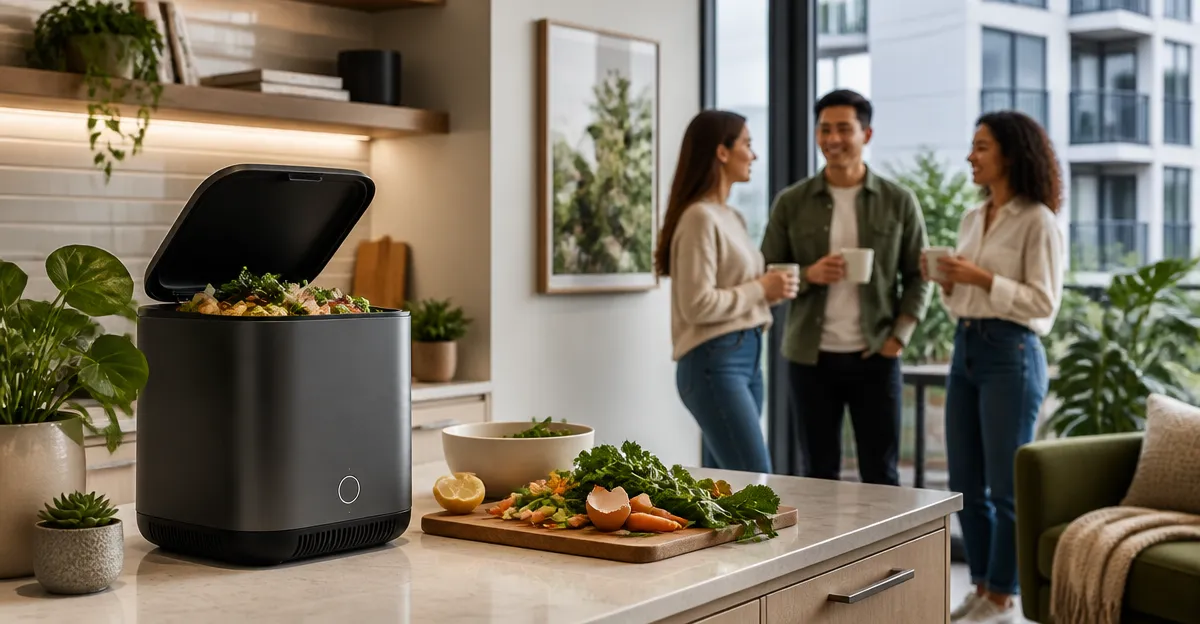
First, a countertop composter directly reduces the volume of organic waste that tenants send to municipal services. By converting scraps into nutrient‑rich material, the building contributes to a circular‑economy model. Second, the visible presence of a sleek compost bin signals that the property embraces modern, health‑oriented design. Third, the amenity can be leveraged in leasing brochures, virtual tours, and social‑media posts to attract tenants who prioritize eco‑friendly living.
When tenants see a functional, odor‑free compost bin, they perceive the building as thoughtfully managed. This perception translates into higher lease renewal rates and positive word‑of‑mouth referrals.
Understanding Tenant Preferences
Surveys conducted in multi‑family complexes reveal three dominant preferences: low odor, easy maintenance, and aesthetic integration with kitchen décor. Tenants also value clear instructions on what can be composted and how often the bin should be emptied. Therefore, the chosen product must excel in these areas.
Property managers should assess the typical household size, cooking habits, and waste‑generation patterns of their resident demographic. For example, a family of four may generate up to 2 lb of food scraps per day, which influences the capacity requirement of the composting solution.
Choosing the Right Composter
Countertop composters fall into two broad categories: passive stainless‑steel bins with charcoal filters and active electric units that accelerate decomposition. Passive models are inexpensive, require no electricity, and rely on natural aerobic processes. Active models use micro‑be or drying technology to produce finished compost in hours, but they have higher upfront costs and require power access.
Below are three recommended products that align with common tenant expectations. The first mention of each product includes a direct affiliate link.
- Epica Kitchen Compost Bin – a 1.3‑gallon stainless‑steel bin with a replaceable charcoal filter, rated 4.6/5 from over 20,000 reviews.
- Reencle Prime Electric Composter – a 14‑liter electric unit that processes up to 2.2 lb of waste daily, featuring whisper‑quiet operation and a three‑layer odor‑control system.
- Utopia Kitchen Compost Bin – a 1.3‑gallon stainless‑steel bin with a charcoal filter, praised for durability and sleek design.
For larger households or properties that wish to showcase cutting‑edge technology, the FRYLINE Electric Kitchen Composter (4 L capacity) and the Airthereal R500 Electric Composter (2.5 L) provide additional options.
Implementation Plan
Step 1 – Conduct a pilot in a sample unit. Install the chosen compost bin in a model apartment, provide a starter pack of charcoal filters (if applicable), and create a concise user guide. Monitor odor levels, resident feedback, and waste‑diversion metrics for four weeks.
Step 2 – Train maintenance staff. Ensure that staff know how to replace filters, empty the bin, and troubleshoot electric units. A quick‑reference checklist reduces response time and keeps the amenity in optimal condition.
Step 3 – Update leasing materials. Include high‑resolution photos of the compost bin on the website, in floor‑plan PDFs, and on social media. Highlight key specifications such as “odor‑free” and “stainless‑steel durability.”
Step 4 – Launch a sustainability campaign. Offer a welcome kit that includes a reusable kitchen waste bag, a printable compost guide, and a QR code linking to a video demonstration. Encourage tenants to share their composting success stories on the community board.
Marketing the Amenity
Use three channels to amplify the composting feature: digital listings, on‑site signage, and resident events. In digital listings, place the phrase “Eco‑Friendly Kitchen Compost Bin Included” near the top of the description. On‑site, hang a small plaque near the kitchen that reads “Your Food Scraps Turn into Garden Gold – Thanks to Our Countertop Composter.”
Host a quarterly “Green Living” workshop where a local horticulturist demonstrates how to use the compost in balcony gardens or community plots. Capture photos and testimonials for future marketing cycles.
Finally, track key performance indicators (KPIs) such as lease‑to‑lease conversion rate, resident satisfaction scores, and waste‑diversion percentages. Report these metrics in annual sustainability reports to demonstrate tangible impact.
Comparison / Selection Guide
| Product | Capacity | Power Requirement | Odor Control | Price (USD) | Rating |
|---|---|---|---|---|---|
| Epica Kitchen Compost Bin | 1.3 gal | None (passive) | Replaceable charcoal filter | 29.98 | 4.6/5 (20,861 reviews) |
| Reencle Prime Electric Composter | 14 L (≈3.7 gal) | Plug‑in | 3‑layer filter system | 499.00 | 4.4/5 (371 reviews) |
| Utopia Kitchen Compost Bin | 1.3 gal | None (passive) | Charcoal filter | 26.99 | 4.5/5 (20,079 reviews) |
| FRYLINE Electric Kitchen Composter | 4 L (≈1 gal) | Plug‑in | Large carbon filter (1000‑hour alert) | 175.32 | 4.2/5 (76 reviews) |
| Airthereal R500 Electric Composter | 2.5 L (≈0.66 gal) | Plug‑in | Biodegradable carbon filter | 169.99 | 4.2/5 (729 reviews) |
When selecting a product, match the capacity to the average daily waste output of your target tenant profile. Passive bins are ideal for budget‑conscious properties, while electric units justify higher rent premiums when marketed as “instant‑compost” solutions.
Best Practices & Tips
- Place the compost bin near the sink but away from direct heat sources to preserve filter efficiency.
- Provide clear signage that lists acceptable materials (vegetable peels, coffee grounds) and prohibited items (bones, oily foods).
- Schedule monthly filter replacements for passive models; keep spare charcoal filters in the maintenance closet.
- Integrate the composting amenity into your property’s sustainability dashboard so residents can see collective waste‑reduction numbers.
- Offer a small incentive—such as a gift‑card to a local garden center—for tenants who consistently use the bin correctly for six months.
By following these guidelines, property managers can minimize odor complaints, extend the lifespan of the equipment, and reinforce the building’s green brand.
Frequently Asked Questions
1. Do countertop composters require electricity?
Passive stainless‑steel bins (e.g., Epica Kitchen Compost Bin, Utopia Kitchen Compost Bin) operate without power, relying on charcoal filters to control odor. Electric models (e.g., Reencle Prime, FRYLINE, Airthereal R500) need a standard outlet but offer faster decomposition.
2. How often must the filter be replaced?
For most charcoal‑filter bins, manufacturers recommend replacement every 3–6 months depending on usage. Electric units typically have a filter life measured in hours; the FRYLINE alerts users at 1,000 hours.
3. Can the compost be used directly in indoor plants?
Passive bins produce partially decomposed material that is safe for houseplants after a short curing period. Electric units produce dried powder that is ideal for outdoor garden beds but should be mixed with soil before indoor use.
4. Will the composting amenity increase utility costs?
Passive models have no impact on electricity bills. Electric units consume modest power (often less than 50 W per cycle), resulting in a negligible increase—typically under $1 per month.
5. Is there a risk of pests?
When the lid remains sealed and the filter is maintained, pest attraction is minimal. Regular cleaning and avoiding meat or oily waste further reduces risk.
6. How can I showcase the amenity in virtual tours?
Include a short video clip of the bin in use, highlight the odor‑free claim, and overlay key specs (capacity, rating). Use the product’s image with a brief caption.
7. What if a tenant reports a malfunction?
Maintain a log of serial numbers and warranty periods. For electric units, contact the manufacturer’s support line within the warranty window; for passive bins, provide a replacement filter or bin as needed.
Conclusion
Integrating a countertop composting amenity offers property managers a tangible way to differentiate their portfolio, attract eco‑aware renters, and contribute to waste‑reduction goals. By selecting the appropriate product, implementing a clear maintenance protocol, and marketing the feature through multiple channels, landlords can achieve higher occupancy rates and stronger resident loyalty.
Remember that the most successful programs combine practical product performance with education and incentives. When tenants understand how easy and rewarding composting can be, the amenity becomes a cornerstone of the community’s sustainable culture.
Products Featured in This Guide
Epica Kitchen Compost Bin
Price: $29.98 | Rating: 4.6/5 (20,861 reviews)
Featured for its affordable price, stainless‑steel durability, and replaceable charcoal filter that ensures odor‑free operation in high‑traffic rentals.
Reencle Prime Electric Composter
Price: $499.00 | Rating: 4.4/5 (371 reviews)
Featured for its rapid 2‑24‑hour decomposition, whisper‑quiet operation, and three‑layer filtration system—ideal for premium apartments seeking a high‑tech green amenity.
Utopia Kitchen Compost Bin
Price: $26.99 | Rating: 4.5/5 (20,079 reviews)
Featured for its slightly larger 1.3‑gallon capacity, sleek stainless‑steel look, and reliable charcoal filter, making it a strong budget alternative to the Epica model.
FRYLINE Electric Kitchen Composter
Price: $175.32 | Rating: 4.2/5 (76 reviews)
Featured for its 4 L capacity, auto‑cleaning modes, and low‑noise operation, suitable for families that generate larger volumes of food waste.
Airthereal R500 Electric Composter
Price: $169.99 | Rating: 4.2/5 (729 reviews)
Featured for its compact 2.5 L size, sharp Trinity Blade technology, and biodegradable carbon filter, offering a balance between cost and performance for smaller units.