Introduction
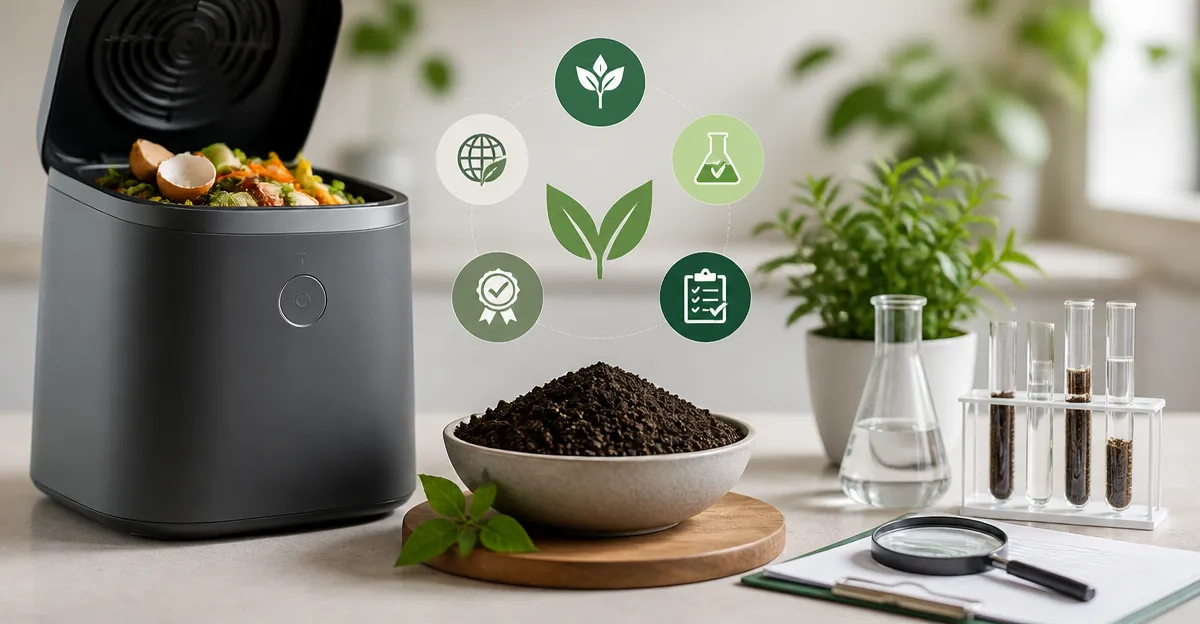
The rise of electric countertop composters has created a new market for small‑scale, processed compost. This guide explains the regulatory landscape, testing protocols, and labeling requirements that apply to compost produced by these devices. Readers will learn how to ensure compliance, select appropriate labeling products, and communicate quality to consumers. The information presented is based on current United States standards and industry best practices.
Background and Context
Compost is defined as a biologically stable material that can be safely returned to soil without adverse effects. Federal agencies such as the Environmental Protection Agency (EPA) and the United States Department of Agriculture (USDA) provide guidance on organic waste processing. Electric countertop composters operate at lower temperatures than industrial facilities, which influences the testing criteria for pathogens, weed seeds, and heavy metals. Understanding these nuances is essential for producers who wish to market their product with confidence.
Understanding Compost Certification Standards
Several certification programs evaluate compost quality. The most widely recognized are the Compost Quality Standard (CQS) and the USDA National Organic Program (NOP). CQS focuses on physical, chemical, and biological parameters such as carbon‑to‑nitrogen ratio, pH, and pathogen reduction. NOP certification is required for compost that will be labeled as "organic" and includes stricter limits on synthetic residues. Both programs require laboratory analysis and documentation of the production process.
Key parameters include:
- Moisture content (typically 30‑55 percent)
- pH range (6.0‑8.0 for most horticultural uses)
- Electrical conductivity (EC) to assess salt levels
- Pathogen indicator organisms such as Salmonella and Escherichia coli
- Heavy metal concentrations within EPA limits
Producers must retain records of feedstock sources, temperature logs, and test results. When these records are audited, certification bodies can verify that the compost meets the declared standards.
Testing Requirements for Processed Compost
Testing is typically performed by an accredited laboratory. The first step is a representative sampling plan that follows the ASTM D 5260 standard for composite samples. Samples are then analyzed for the parameters listed above. For countertop units, the temperature profile rarely exceeds 60 °C, so additional treatment steps such as pasteurization may be required to meet pathogen reduction criteria.
Common test methods include:
- Moisture – gravimetric drying at 105 °C (ASTM D 2216)
- pH – aqueous extraction with a calibrated pH meter (ASTM D 4972)
- EC – conductivity meter after a 1:5 water extract (ASTM D 4972)
- Pathogen – most probable number (MPN) technique for E. coli (EPA Method 1603)
- Heavy metals – inductively coupled plasma (ICP) spectroscopy (EPA Method 6020)
Results must be compared against the limits established by the chosen certification program. If any parameter exceeds the limit, corrective actions such as additional curing time or blending with higher‑quality material are required.
Labeling Requirements and Best Practices
Accurate labeling communicates the compost’s origin, certification status, and intended use. Federal law requires that any claim of "organic" be supported by USDA‑NOP certification. Labels must also include the producer’s name, lot number, and a clear statement of the material’s composition. For countertop‑generated compost, it is advisable to use durable, weather‑proof stickers that can be applied to storage bins and packaging.
When selecting labeling products, consider the following criteria:
- Weather resistance – stickers should remain legible outdoors for at least one year.
- Adhesion strength – the backing must adhere to metal, plastic, and painted surfaces without peeling.
- Visibility – high‑contrast symbols and large fonts improve user compliance.
- Ease of application – peel‑and‑stick designs reduce installation time.
For indoor bin labeling, the Sutter Signs Trash Compost Recycle Stickers provide weatherproof vinyl, bright symbols, and a strong adhesive. They are rated 4.7 stars by 121 reviewers and cost $7.99 for a six‑pack, making them a cost‑effective option for residential users.
For commercial kitchens or office spaces, the Pixelverse Compost Stickers offer UV‑resistant lamination and a larger 4 × 4 inch format. With a 4.6‑star rating from 501 reviews and a price of $6.99, they combine durability with affordability.
The SmartSign Compost Labels are designed for high‑visibility indoor use, measuring 3.75 × 9 inches and featuring a laminated polyester surface. At $9.79 per pack of four and a 4.4‑star rating, they are suitable for larger containers that require a rectangular format.
For users who need a versatile set that includes trash, recycle, and compost symbols, the IGNIXIA Compost Stickers provide six 4 × 4 inch decals with waterproof, UV‑resistant PVC vinyl. They are priced at $5.99 and have earned a 4.5‑star rating from 327 reviewers.
Finally, the Fuel Stickers Compost Labels are heavy‑duty, USA‑made stickers that measure 6 × 2 inches and come with a three‑year warranty. At $8.99 for a set of four and a 4.3‑star rating, they are an excellent choice for outdoor community gardens and public parks.
Comparison and Selection Guide
| Product | Size | Material | Weatherproof | Price (USD) | Rating | Best For |
|---|---|---|---|---|---|---|
| Sutter Signs Trash Compost Recycle Stickers | 4" round | Outdoor‑rated vinyl | Yes | 7.99 | 4.7/5 (121 reviews) | Residential indoor/outdoor bins |
| Pixelverse Compost Stickers | 4" × 4" square | Industrial‑grade vinyl with UV lamination | Yes | 6.99 | 4.6/5 (501 reviews) | Commercial kitchens and offices |
| SmartSign Compost Labels | 3.75" × 9" rectangular | Laminated polyester | Limited (indoor focus) | 9.79 | 4.4/5 (39 reviews) | Larger containers and educational settings |
| IGNIXIA Compost Stickers | 4" × 4" square (pack of 6) | PVC vinyl, waterproof | Yes | 5.99 | 4.5/5 (327 reviews) | Mixed‑use households needing multiple symbols |
| Fuel Stickers Compost Labels | 6" × 2" rectangular | Heavy‑duty, USA‑made material | Yes (indoor/outdoor) | 8.99 | 4.3/5 (142 reviews) | Community gardens and public parks |
When choosing a product, match the sticker size to the bin surface area, verify that the material can endure the expected exposure, and consider the aesthetic preferences of the end user. The table above provides a quick reference to assist in that decision.
Best Practices and Tips
- Maintain a documented feedstock log for every batch of compost; this simplifies certification audits.
- Perform temperature monitoring during the composting cycle; aim for a minimum of 55 °C for at least three days to reduce pathogen risk.
- Apply labels to clean, dry surfaces; use a soft cloth to remove dust before adhering stickers.
- Rotate label placement on bins to avoid wear in high‑traffic areas; replace stickers annually or when they show signs of fading.
- Include a QR code on the label that links to a digital certificate; this adds transparency for consumers.
Frequently Asked Questions
1. Do I need USDA‑NOP certification for compost from a countertop unit?
Only if you intend to market the product as "organic". For general horticultural use, compliance with the Compost Quality Standard is sufficient.
2. How often should I test my compost for pathogens?
Testing should be performed on each production batch until a consistent pathogen‑free record is established, after which quarterly testing is acceptable.
3. Can I reuse the same stickers on different bins?
Most vinyl stickers are removable but not designed for repeated reuse. Removing and reapplying may reduce adhesion strength and compromise legibility.
4. What is the minimum label size required by certification bodies?
There is no universal minimum size, but the label must be large enough for the required information to be read from a distance of at least one foot. A 4 × 4 inch format typically satisfies this requirement.
5. Are there any environmental concerns with the adhesive used on these stickers?
Most products listed use pressure‑sensitive adhesives that are free of solvents. They are considered safe for indoor and outdoor use and do not leach harmful chemicals.
6. How can I verify that my compost meets heavy‑metal limits?
Submit a sample to an EPA‑accredited laboratory for ICP analysis. The results will indicate concentrations of lead, cadmium, arsenic, and other regulated metals.
7. Is a QR code required on compost labels?
It is not required, but many producers include a QR code to provide instant access to certification documents and usage guidelines.
Conclusion
Compliance with compost certification, testing, and labeling standards ensures that processed compost from electric countertop units is safe, effective, and marketable. By following the testing protocols, maintaining thorough documentation, and selecting appropriate labeling products, producers can achieve certification and build consumer trust. The products highlighted in this guide offer reliable, weather‑proof solutions that meet the practical needs of both residential and commercial users.
Products Featured in This Guide
Sutter Signs Trash Compost Recycle Stickers
Price: $7.99 | Rating: 4.7/5 (121 reviews)
Featured for its weatherproof vinyl, bright symbols, and strong adhesive that suit both indoor and outdoor bin labeling.
Pixelverse Compost Stickers
Price: $6.99 | Rating: 4.6/5 (501 reviews)
Featured for UV‑resistant lamination, large 4 × 4 inch size, and suitability for commercial kitchens and offices.
SmartSign Compost Labels
Price: $9.79 | Rating: 4.4/5 (39 reviews)
Featured for its laminated polyester construction and rectangular format that works well on larger containers.
IGNIXIA Compost Stickers
Price: $5.99 | Rating: 4.5/5 (327 reviews)
Featured for its complete set of trash, recycle, and compost symbols and durable waterproof PVC material.
Fuel Stickers Compost Labels
Price: $8.99 | Rating: 4.3/5 (142 reviews)
Featured for its heavy‑duty construction, USA manufacturing, and three‑year warranty suitable for outdoor community applications.