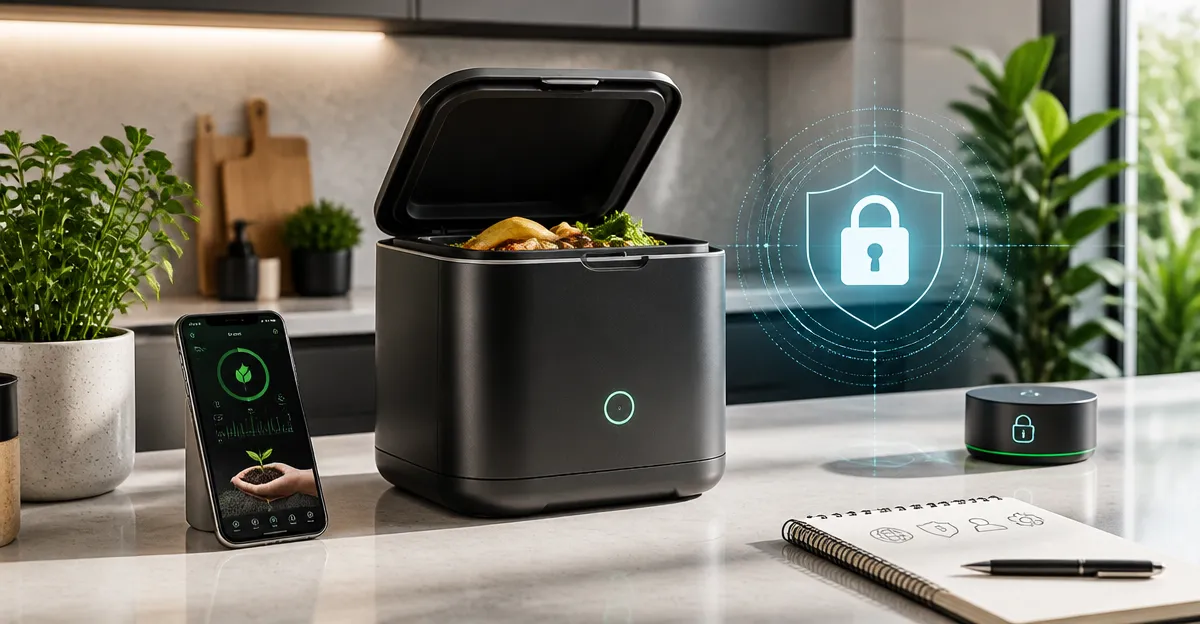
Smart Countertop Composter Data Privacy Guide: Best Practices to Protect Your Smart Kitchen and Composting Data
Introduction
The modern kitchen increasingly relies on connected appliances that streamline daily chores while generating valuable data. A smart countertop composter exemplifies this trend by monitoring temperature, moisture, and usage patterns to optimise organic waste breakdown. This guide explains the privacy implications of such devices, outlines essential concepts, and recommends authoritative resources that empower users to safeguard personal and household information. Readers will learn how data flows from a composter, how to evaluate privacy‑focused products, and which practical steps minimise exposure without sacrificing convenience.
Background and Context
Connected composters belong to the broader Internet of Things (IoT) ecosystem, where sensors transmit data to cloud platforms for analysis. The data may include timestamps, location identifiers, and behavioural insights that, when combined with other sources, could reveal sensitive lifestyle patterns. Regulations such as the General Data Protection Regulation (GDPR) and the California Consumer Privacy Act (CCPA) impose obligations on manufacturers and users alike. Understanding the legal landscape, encryption fundamentals, and consent mechanisms is essential before integrating a smart composter into a household network.
Understanding Smart Countertop Composters
Smart composters employ micro‑controllers, Wi‑Fi or Bluetooth modules, and mobile applications to deliver real‑time feedback. Key data points include:
- Temperature and humidity readings that optimise decomposition cycles.
- Usage frequency, which indicates how often waste is added or removed.
- Device identifiers that link the unit to a specific user account.
Manufacturers often store this information on cloud servers to provide analytics dashboards. While these services improve user experience, they also create potential attack vectors if data is not encrypted or if access controls are weak.
Data Collection Points and Risks
Data collection occurs at three primary stages: sensor capture, transmission, and storage. At the sensor level, inadequate firmware security can allow unauthorized firmware modifications. During transmission, unencrypted Wi‑Fi packets expose data to eavesdropping. Finally, cloud storage may be vulnerable to breaches if the provider does not implement robust access management. Users should verify that manufacturers adopt industry‑standard TLS encryption, regular security patches, and transparent privacy policies.
Secure Connectivity Options
Choosing a secure network configuration reduces exposure. Recommended practices include:
- Connecting the composter to a dedicated IoT VLAN that isolates it from personal devices.
- Enabling WPA3 encryption on the Wi‑Fi network to prevent credential theft.
- Utilising a VPN when accessing the device remotely, ensuring that traffic is encrypted end‑to‑end.
When the device supports Bluetooth Low Energy (BLE), users should pair only with trusted smartphones and disable discoverability after pairing.
Privacy Settings and User Controls
Most companion apps provide privacy dashboards where users can manage data sharing preferences. Important controls include:
- Opt‑out of anonymous analytics that aggregate usage data for product improvement.
- Delete historical data from the cloud after a defined retention period.
- Review third‑party integrations that may transmit data to advertising networks.
Regularly reviewing these settings ensures that data collection aligns with personal comfort levels and regulatory requirements.
Recommended Privacy‑Focused Resources
Understanding privacy principles extends beyond device configuration. The following publications provide in‑depth guidance for building and maintaining privacy programs that complement smart kitchen technology.
The first recommended resource is Data Privacy Program Guide. This Kindle edition, authored by Matt Stamper, Justine Phillips, David Goodman, and Bill Bonney, offers a step‑by‑step framework for establishing a privacy program that inspires trust. At a price of $50.26, the guide holds a rating of 4.1 out of 5 based on 16 reviews, indicating solid industry relevance.
The second resource, Data Privacy & Compliance Handbook, is a paperback authored by Aaron T. Langford. Priced at $24.99 and currently in stock, it provides practical insight into GDPR, CCPA, ISO 27001, and secure data governance for security and cloud professionals. Its perfect 5‑star rating, though based on a single review, reflects the author’s expertise.
For readers interested in artificial‑intelligence‑driven threats, Privacy-First AI Security offers a Kindle edition by Joel LeBlanc that addresses prompt injection, retrieval‑augmented generation (RAG) data leaks, and LLM red‑team techniques. At $8.99 and a flawless 5‑star rating, it equips users with real‑world controls that protect AI‑enabled kitchen assistants.
Finally, Privacy By Design Guide presents a comprehensive paperback from The Art of Service – Privacy By Design Publishing. With a price of $89.97, a 5‑star rating, and in‑stock availability, this volume emphasises embedding privacy considerations during product design, a principle directly applicable to smart countertop composters.
Comparison and Selection Guide
When selecting a privacy resource, users should evaluate three criteria: depth of coverage, applicability to IoT environments, and price‑to‑value ratio.
| Resource | Focus Area | Depth | Price | Rating |
|---|---|---|---|---|
| Data Privacy Program Guide | Program development and governance | Comprehensive | $50.26 | 4.1/5 |
| Data Privacy & Compliance Handbook | Regulatory compliance for cloud professionals | Practical | $24.99 | 5/5 |
| Privacy-First AI Security | AI‑specific threats and controls | Targeted | $8.99 | 5/5 |
| Privacy By Design Guide | Embedding privacy in product design | Strategic | $89.97 | 5/5 |
For households seeking a holistic privacy program, the Data Privacy Program Guide offers the most extensive methodology. Professionals focused on regulatory checklists may prefer the Data Privacy & Compliance Handbook. Users concerned about AI‑driven vulnerabilities should select Privacy-First AI Security, while designers aiming to incorporate privacy from inception will benefit from the Privacy By Design Guide.
Best Practices & Tips
- Document all data flows from the composter to cloud services, noting encryption methods and retention periods.
- Perform firmware updates within 30 days of release to mitigate known vulnerabilities.
- Disable unnecessary data sharing features in the companion app, especially those that transmit anonymised analytics.
- Implement multi‑factor authentication (MFA) on the manufacturer’s web portal to prevent unauthorized account access.
- Regularly audit third‑party integrations for compliance with privacy standards outlined in the recommended resources.
Applying these actions creates a layered defense that aligns with both technical safeguards and organizational privacy policies.
Frequently Asked Questions
- 1. Does a smart composter store personal identifiers?
- Most devices associate usage data with a unique device identifier rather than a name; however, the companion app may link the identifier to an email address or account profile.
- 2. Can I completely disable data collection?
- Some manufacturers allow a “local‑only” mode that disables cloud sync, but this may limit advanced features such as predictive maintenance alerts.
- 3. How often should I change my Wi‑Fi password?
- Changing the password every six months reduces the risk of credential compromise, especially for devices that rarely receive firmware updates.
- 4. Are there open‑source alternatives to proprietary cloud platforms?
- Open‑source IoT frameworks exist, but they require technical expertise to host and maintain securely; they are not typically offered by mainstream smart composter manufacturers.
- 5. What legal rights do I have under GDPR for data collected by a kitchen device?
- Under GDPR, you have the right to access, rectify, delete, and restrict processing of personal data, as well as the right to data portability.
- 6. Does enabling a VPN affect composter performance?
- VPN overhead may introduce slight latency, but most composters transmit small data packets, so performance impact is minimal.
Conclusion
Protecting data from smart countertop composters requires a combination of technical safeguards, informed configuration, and a solid understanding of privacy frameworks. By applying the strategies outlined in this guide, users can enjoy the convenience of automated composting while maintaining control over personal information. The recommended publications provide deeper insight into program development, regulatory compliance, AI‑related threats, and privacy‑by‑design principles, ensuring that readers are equipped to make informed decisions.
Products Featured in This Guide
Data Privacy Program Guide
Price: $50.26 | Rating: 4.1/5 (16 reviews)
Featured because it delivers a comprehensive framework for building privacy programs that can be applied to IoT devices such as smart composters.
Data Privacy & Compliance Handbook
Price: $24.99 | Rating: 5/5 (1 review) | Availability: In Stock
Featured for its practical guidance on GDPR, CCPA, and ISO 27001, which are directly relevant to the data handling practices of smart kitchen appliances.
Privacy-First AI Security
Price: $8.99 | Rating: 5/5 (0 reviews)
Featured because it addresses emerging AI threats such as prompt injection, which can affect voice‑controlled kitchen assistants linked to composters.
Privacy By Design Guide
Price: $89.97 | Rating: 5/5 (1 review) | Availability: In Stock
Featured for its emphasis on integrating privacy considerations during product design, a principle that manufacturers of smart composters should adopt.