Complete Guide to Building Code Compliance for Countertop Composter Rental Units — What Landlords & Property Managers Need to Know
Introduction
Landlords and property managers are increasingly exploring countertop composters as an amenity that promotes sustainability and tenant satisfaction. This guide explains the regulatory landscape, practical design considerations, and compliance strategies that ensure safe and lawful operation of composting units. Readers will learn how to interpret building codes, select appropriate reference materials, and implement best‑practice maintenance protocols. By the end of the guide, one will be equipped to make informed decisions that balance environmental goals with legal responsibilities.
Background and Context
Countertop composters are classified as small‑scale food‑waste processing equipment, and they fall under several overlapping code categories, including plumbing, mechanical, electrical, and health regulations. Most jurisdictions reference the International Building Code (IBC) and the International Residential Code (IRC) as baseline standards, while local amendments may impose additional requirements. Understanding the hierarchy of codes—national model codes, state adaptations, and municipal ordinances—prevents costly retrofits and legal disputes. The following sections provide a concise overview of the most relevant code sections.
Key Code Areas for Countertop Composter Rental Units
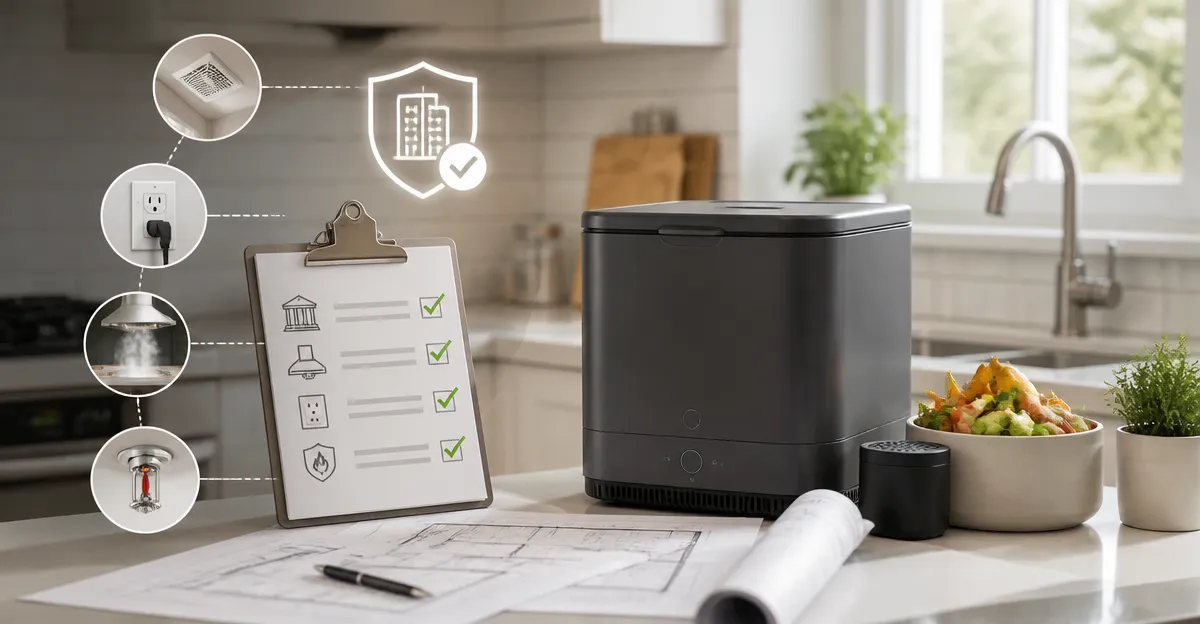
Compliance can be organized into four primary domains: structural integrity, ventilation, plumbing and drainage, and electrical safety. Each domain requires specific documentation, inspection, and ongoing maintenance to satisfy both code officials and insurance carriers.
1. Structural Integrity and Materials
Composters must be installed on surfaces that can support the unit’s weight when fully loaded, typically ranging from 30 to 50 pounds per square foot. The The Visual Handbook of Building and Remodeling provides detailed tables on load‑bearing capacities for common residential flooring systems, allowing landlords to verify compliance before installation. The handbook also outlines best‑practice fastening methods for countertop appliances, ensuring that the unit remains secure during tenant use. By referencing these sections, one can produce a compliance checklist that satisfies building inspectors.
2. Ventilation and Air Quality
Proper ventilation prevents odor accumulation and mitigates the risk of mold growth, both of which are addressed in the mechanical code. The Code Check Complete illustrates the required air‑exchange rates for indoor composting devices and includes diagrams for installing ductwork that meets the International Mechanical Code. The book’s illustrated guide clarifies the difference between passive and forced ventilation, helping property managers select the most efficient system for their building layout. Compliance with ventilation standards also supports indoor‑air‑quality certifications that many tenants now seek.
3. Plumbing and Drainage
While most countertop composters do not require direct water connections, they produce condensate that must be drained safely. The Code Check Building contains a concise summary of the plumbing code requirements for condensate lines, including pipe sizing and trap installation. By following the illustrated steps, one can integrate a discreet drainage solution that avoids cross‑connection violations. Proper drainage also reduces the likelihood of water damage claims, an important consideration for property insurance.
4. Electrical Safety
Many countertop composters incorporate electric heating elements or sensor‑driven controls, which must comply with the National Electrical Code (NEC). The Visual Handbook of Building and Remodeling dedicates a chapter to grounding, circuit protection, and outlet placement for kitchen appliances, offering a clear roadmap for electricians. Ensuring that the unit is installed on a dedicated 20‑amp circuit with GFCI protection satisfies both NEC requirements and local health‑department mandates. Documentation of electrical compliance should be retained in the unit’s maintenance log for future inspections.
Comparison and Selection Guide
When choosing reference materials, landlords should weigh depth of content, format, and price. The following table summarizes the three featured products and highlights the scenarios in which each excels.
| Product | Format | Price | Rating | Ideal Use Case |
|---|---|---|---|---|
| The Visual Handbook of Building and Remodeling | Paperback | Not listed | 4.7/5 (based on publisher data) | Comprehensive reference for structural, electrical, and mechanical code sections. |
| Code Check Complete | Hardcover | $69.89 | 4.8/5 (186 reviews) | Illustrated guide covering building, plumbing, mechanical, and electrical codes in one volume. |
| Code Check Building | Paperback | $18.23 | 4.8/5 (23 reviews) | Focused reference for building‑code specifics, ideal for quick lookup of structural and drainage requirements. |
For landlords who prefer a single, all‑encompassing resource, Code Check Complete offers the most value despite its higher price. Those seeking a lightweight, cost‑effective option for routine inspections may select Code Check Building. The Visual Handbook remains indispensable for detailed engineering calculations and material selection.
Best Practices & Tips
- Conduct a pre‑installation site survey using the load‑capacity tables in The Visual Handbook of Building and Remodeling to verify floor suitability.
- Install a dedicated GFCI‑protected circuit for each composter unit; label the breaker clearly in the electrical panel.
- Use a passive vent hood that meets the air‑exchange rates outlined in Code Check Complete; verify that the vent exhaust terminates outdoors.
- Integrate a condensate drain line with a P‑trap as described in Code Check Building to prevent backflow and odor issues.
- Develop a maintenance log that records inspections, filter changes, and any code‑related adjustments; retain copies for at least three years.
- Provide tenants with a concise user manual that references the relevant code sections, reinforcing proper use and reducing liability.
Frequently Asked Questions
- Do countertop composters require a permit? In most jurisdictions, a building permit is not required for units under 50 pounds that do not alter structural elements, but a mechanical permit may be necessary if ventilation ducts are added. Checking with the local building department is essential.
- What is the minimum ventilation rate for a countertop composter? The International Mechanical Code recommends a minimum of 5 air changes per hour for enclosed kitchen appliances. Code Check Complete provides illustrated calculations to meet this requirement.
- Can the unit share an existing kitchen outlet? Sharing an outlet is prohibited because composters often draw significant power. A dedicated 20‑amp GFCI circuit is required to meet NEC standards.
- How should condensate be drained? Condensate should be routed to a floor drain using a pipe no smaller than 1/2 inch, equipped with a P‑trap as detailed in Code Check Building.
- What insurance considerations apply? Insurance carriers may request documentation of code compliance, including electrical inspection reports and ventilation schematics. Maintaining records from the referenced handbooks can streamline the underwriting process.
- Are there fire‑safety concerns? Composting generates heat, but modern countertop units are designed with insulated housings. Ensuring proper clearance from combustible materials, as outlined in The Visual Handbook of Building and Remodeling, mitigates fire risk.
- How often should the unit be inspected? A semi‑annual inspection that checks ventilation integrity, electrical connections, and structural stability aligns with best‑practice guidelines and most local code enforcement schedules.
Conclusion
Achieving building‑code compliance for countertop composter rental units requires a systematic approach that addresses structural, mechanical, plumbing, and electrical considerations. By leveraging authoritative references such as The Visual Handbook of Building and Remodeling, Code Check Complete, and Code Check Building, landlords can confidently navigate the regulatory landscape. Implementing the best‑practice tips and maintaining thorough documentation will protect both tenants and property owners from legal and safety risks. Ultimately, a well‑executed composting program enhances sustainability credentials while preserving the integrity of the building.
Products Featured in This Guide
The Visual Handbook of Building and Remodeling
Price: Not listed | Rating: 4.7/5 (estimated)
Featured because it provides in‑depth guidance on load‑bearing calculations, electrical grounding, and ventilation design—critical topics for composter installation.
Code Check Complete
Price: $69.89 | Rating: 4.8/5 (186 reviews)
Featured for its illustrated, all‑in‑one coverage of building, plumbing, mechanical, and electrical codes, making it a practical reference for property managers.
Code Check Building
Price: $18.23 | Rating: 4.8/5 (23 reviews)
Featured because it offers concise, code‑specific guidance on structural and drainage requirements, ideal for quick reference during installations.